Landing page definition
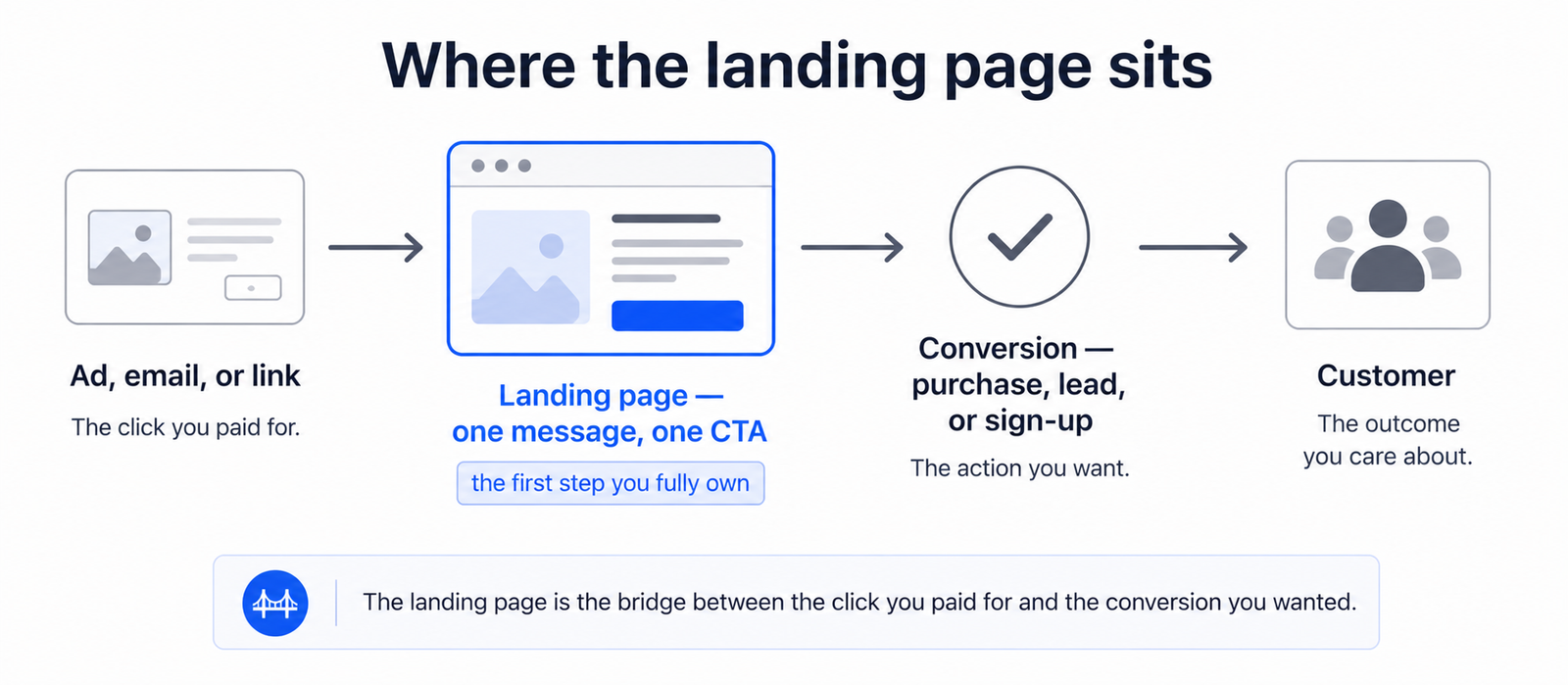
In digital marketing, a landing page is the destination a visitor reaches after clicking a specific link — a Meta or Google ad, an email, an influencer's link, a QR code. Unlike ordinary web pages, it isn't built to be browsed; it's built to convert one known audience toward one action, which is why it typically strips out navigation, sidebars, and every other exit. The term gets used loosely (analytics tools call any entry page a "landing page"), but in the campaign sense it means a purpose-built, single-goal page. It sits at a precise point in the funnel: after the click, before the conversion — the first piece of the journey you fully own.
The 5 main types of landing pages
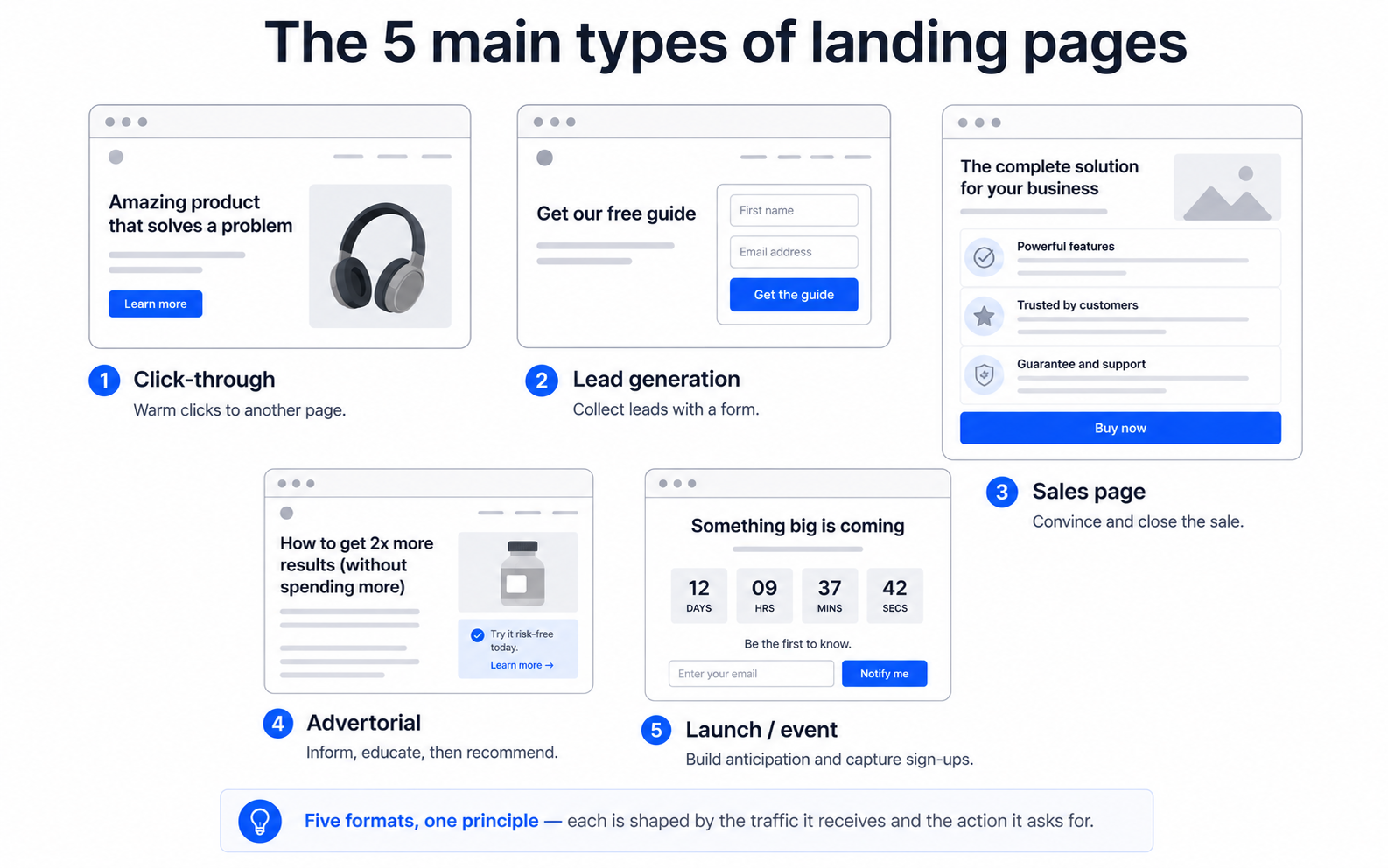
Click-through pages warm a paid visitor up before sending them to checkout — the workhorse of ecommerce campaigns. Lead generation pages trade something valuable (a guide, a quote, a discount code) for contact details via a form; the minimal version, a squeeze page, asks for nothing but an email — both are the territory of our lead generation landing pages. Sales pages carry the full persuasion load for a single product, running as long as the decision requires. Advertorial pages rebuild context for cold social traffic in an editorial format before introducing the product — the highest-converting format we build for cold Meta audiences. Launch and event pages (waitlists, webinars, app downloads) capture intent before or around a moment in time.
The anatomy of a landing page
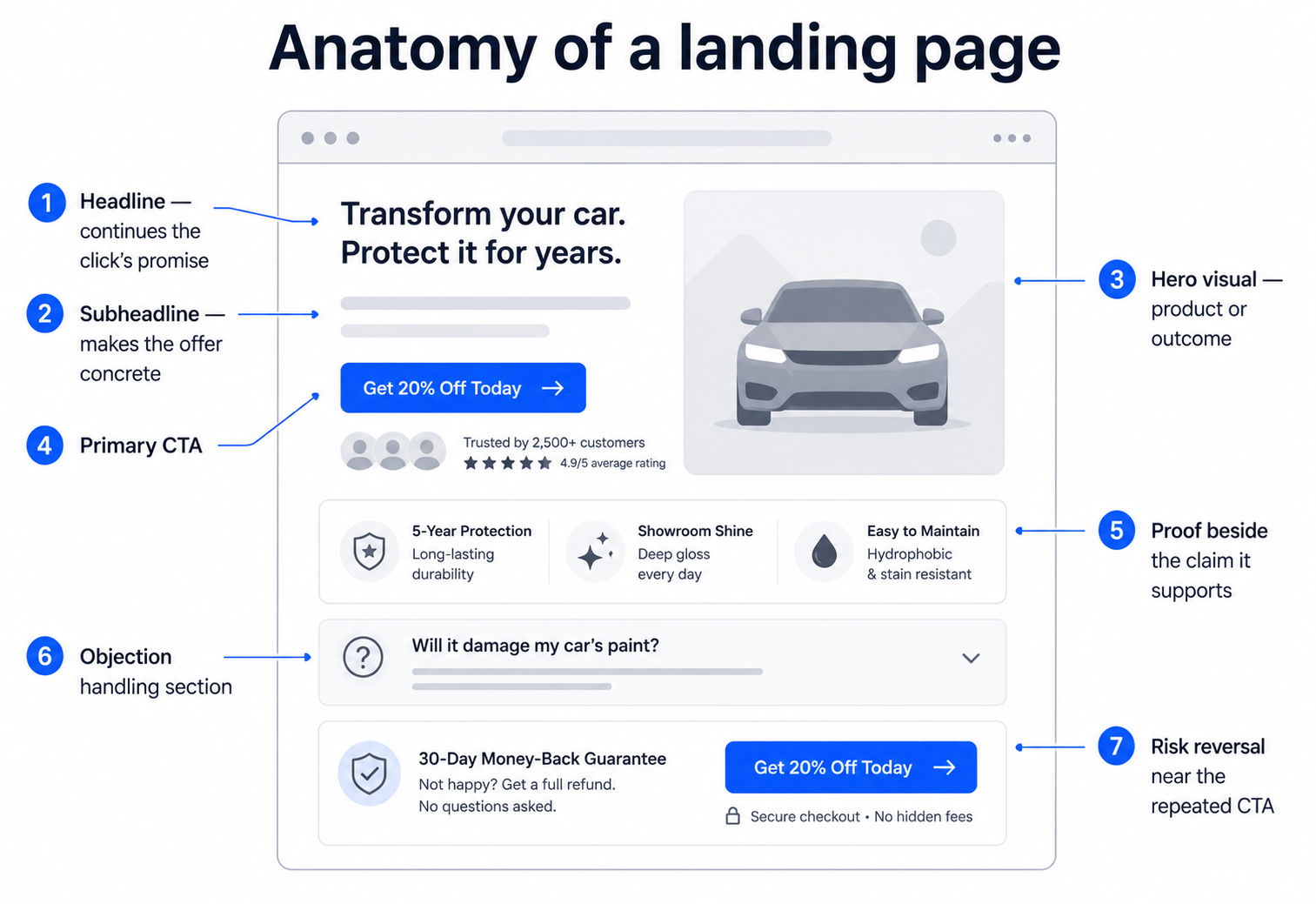
Whatever the type, high-converting landing pages share a skeleton: a headline that continues the promise of the click; a subheadline that makes the offer concrete; a hero visual showing the product or outcome rather than decoration; one call to action, placed above the fold and repeated at decision moments; proof — reviews, results, logos — positioned next to the claims it supports; an objection-handling section that names the reasons people hesitate; and risk reversal (guarantee, free returns) near the CTA. The full working standard for each element, with a pre-launch checklist, is in our landing page best practices guide.
Landing page vs homepage vs product page
A homepage serves everyone and therefore converts no one in particular; a product page serves shoppers who are already browsing the store; a landing page serves one campaign's visitors and nothing else. The difference isn't cosmetic — it's who the page assumes is reading and what it lets them do next. The full comparison, including when each is the right destination and the data on homepage campaigns, is in our landing page vs website guide.
Why landing pages matter: the economics
The case for landing pages is arithmetic, not aesthetics. When a page matches its ad, more of the same traffic converts — across our client accounts, moving paid campaigns from generic destinations to dedicated landing pages lifts conversion by an average of 38%, which mechanically cuts cost per acquisition by roughly 30% on the same spend. The second-order benefit compounds: dedicated URLs produce clean per-campaign data, which makes meaningful A/B testing possible, and testing is what keeps improving the number quarter after quarter — the full methodology is in our landing page optimization guide. An ad budget without landing pages isn't saving money; it's paying full price for half the conversions.
Want to know what a dedicated page would do to your CPA?
Get the free 10-point audit →What does a good landing page look like?
Focused, fast, and specific. The best pages read like the ad's natural next sentence, put the offer and CTA in the first viewport, load in under 2.5 seconds on a phone, and use real product proof instead of stock imagery. Style varies wildly by brand — minimal or maximal, short or long — but the discipline underneath is constant. To see it applied, with the results attached, browse our landing page examples gallery.
How do you get a landing page?
Three routes. Build it yourself with a hosted tool — our landing page builders comparison maps the options and where each gates its features. Hire a freelancer, which buys production but usually not strategy. Or use a specialist service that handles research, copy, design, and build as one system — which is what our landing page design service does, with pages live in 7–14 days. The honest rule: the tool or vendor matters less than whether someone competent owns the strategy and the copy, because those are the layers conversion actually comes from.