What is the difference between a landing page and a website?
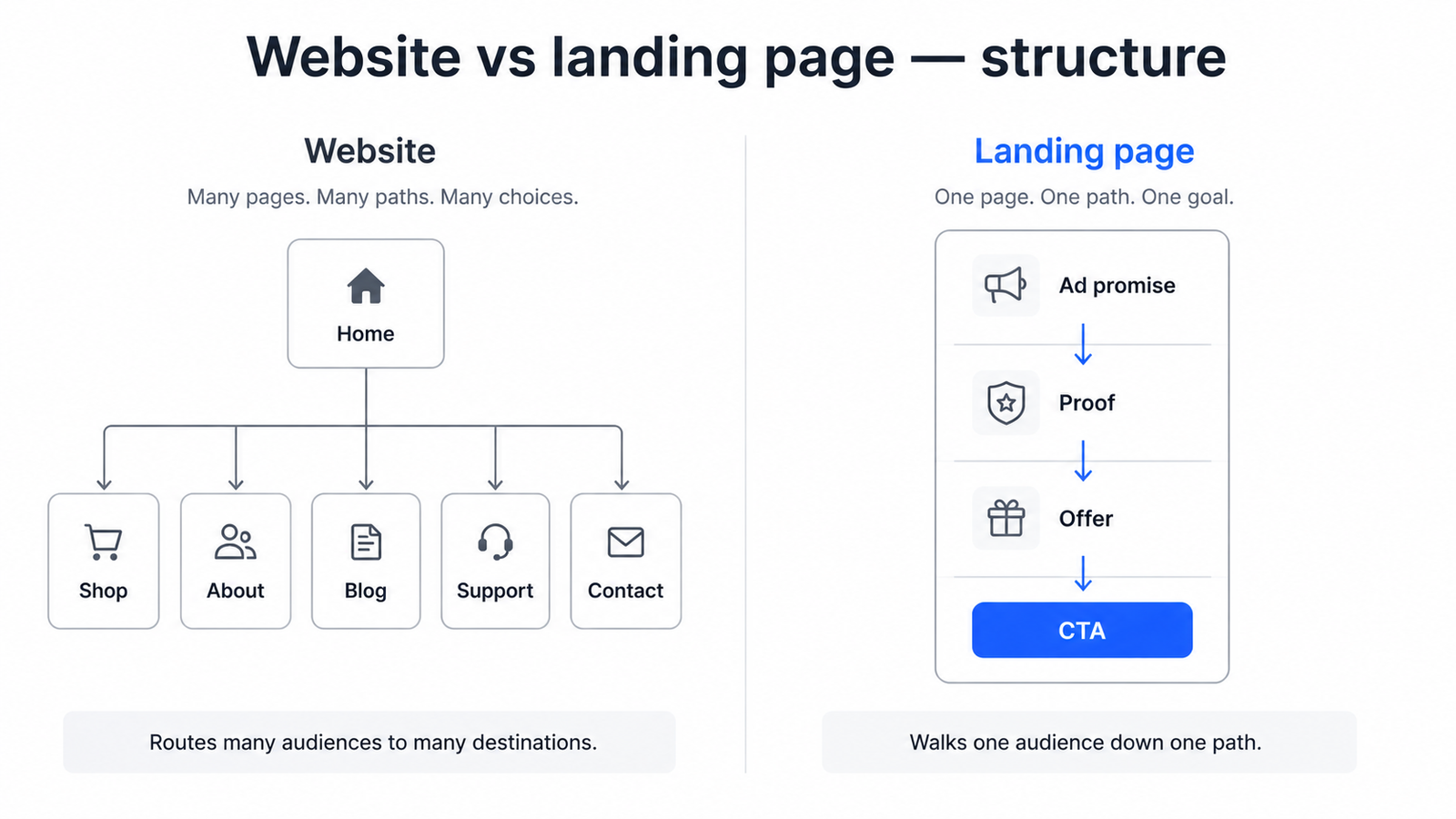
A website is a connected system of pages serving every audience a business has: shoppers, researchers, job applicants, journalists, existing customers looking for support. Its navigation exists precisely because visitors arrive with different goals and need to route themselves. A landing page is the opposite instrument — a standalone page with one audience, one message, and one conversion goal, usually with navigation removed entirely. The visitor arrives from a known source (an ad, an email, a QR code), so the page can speak to exactly that context instead of hedging for everyone.
The practical differences follow from that purpose:
| Dimension | Landing page | Website |
|---|---|---|
| Goal | One conversion action | Many goals — browse, learn, contact, support |
| Audience | One traffic source, known context | Every audience the business has |
| Navigation | Removed or minimal | Full menu, footer, internal links |
| Message | Matched to the specific ad or campaign | General brand positioning |
| Success metric | Conversion rate, CPA | Engagement, SEO traffic, assisted conversions |
| Lifespan | Campaign-bound, iterated by testing | Long-lived, evolves with the brand |
Landing page vs homepage: why ads shouldn't point home
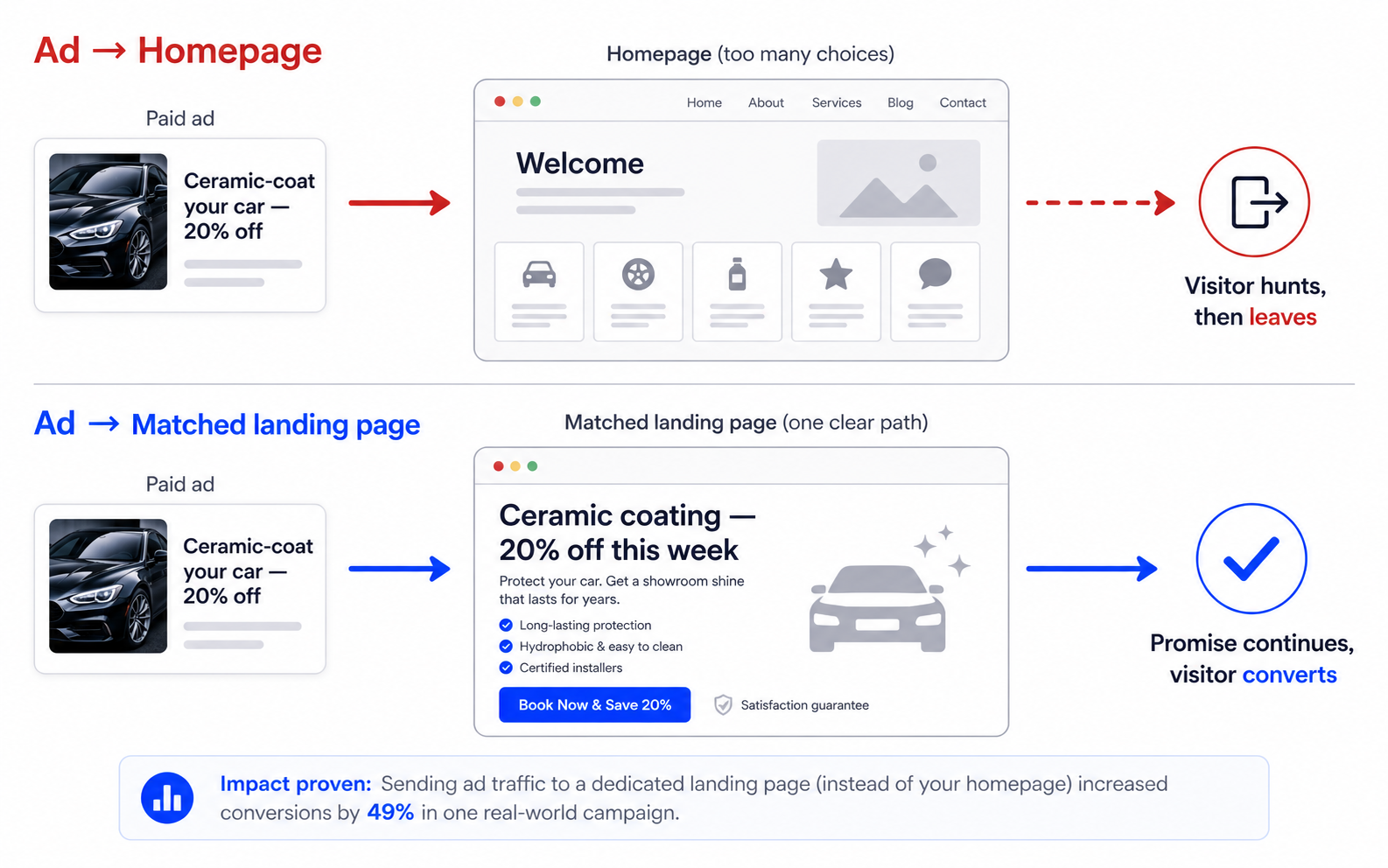
The homepage is the most common — and most expensive — landing page mistake. A homepage is the front door for everyone, which means it commits to no one: generalized headline, full navigation, a dozen possible paths. Send a $2 click from a specific ad to that page and the visitor must re-find the thing the ad promised among everything else you do. Most don't bother. In our client data, replacing a homepage destination with a campaign-matched landing page produces some of the largest single lifts we ever measure — our beauty brand case ran +49% conversion versus the homepage baseline, statistically significant inside three weeks.
When should you use a landing page?
Use a dedicated landing page whenever the visitor's context is known and the goal is singular: paid social and search campaigns, email promotions, influencer and affiliate links, product launches, seasonal offers, webinar registrations, and lead magnets. The rule of thumb: if you're paying for the click or the placement, the destination should be purpose-built for it. One page per major campaign angle keeps message match tight and test data clean — this is exactly what our landing page design service produces.
When is a website the right tool?
The website earns its keep everywhere intent is self-directed: organic search and SEO content, brand-curious visitors who'll explore before trusting, returning customers, support and account flows, press and careers. A business obviously needs both — the mistake isn't owning a website, it's making the website do a landing page's job. Informational content like this guide belongs on the site; the campaign destination it links to belongs on a landing page.
Why the winning setup is both, connected
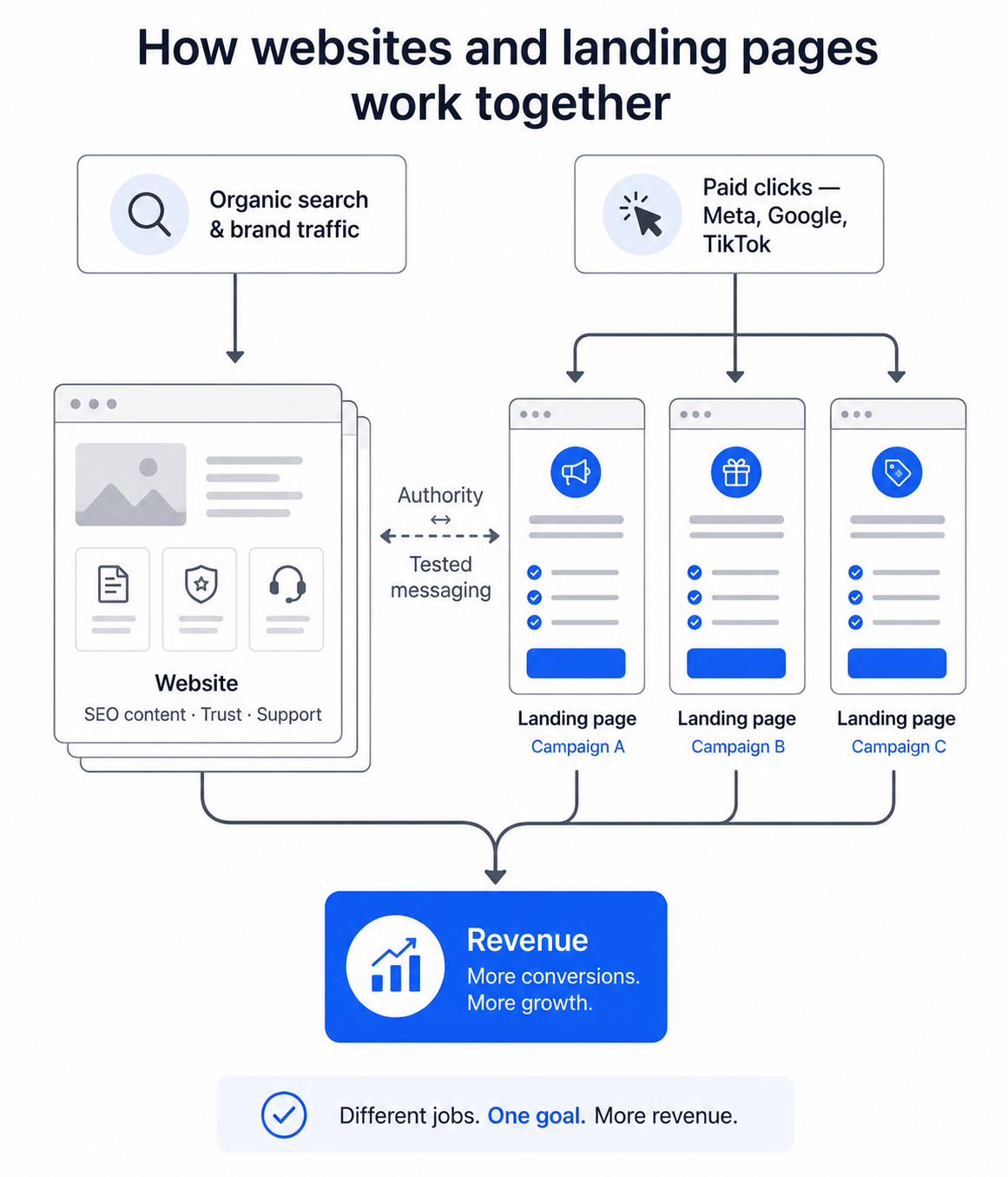
Mature DTC funnels run a clean division of labour: the website handles organic discovery, brand trust, and lifecycle traffic, while a stable of landing pages — one per campaign angle — receives every paid click. The two reinforce each other: site content builds the authority that makes landing page claims believable, and landing page tests reveal messaging that often migrates back into the site. Brands at scale typically maintain several active landing pages at once, retired and replaced as campaigns rotate, often through a continuous optimization program.
Why do landing pages convert better than websites?
Three mechanisms, all measurable. Choice removal: every navigation link is an exit ramp; removing them removes deliberation. Message match: a page written for one ad and one audience can use their exact language and answer their exact objections, which a generalized page cannot. Attribution clarity: a dedicated URL per campaign produces clean data, which makes testing possible, which compounds conversion over time. None of this requires the landing page to be prettier than the website — only more focused; what a focused page contains, element by element, is covered in our landing page best practices guide. If you want to know what a focused page would do to your current numbers, the free 10-point audit answers that for your funnel specifically, or you can read what those pages look like in our what is a landing page primer.