What is landing page optimization?
Landing page optimization (LPO) is the systematic process of improving a page's conversion rate through research, hypothesis-driven changes, and controlled testing. It's a subset of conversion rate optimization (CRO) focused on the single highest-leverage asset in a paid funnel — the page every purchased click lands on. Done properly, it's an evidence loop: observe where visitors leak, diagnose why, test a fix, keep the winners, and repeat. Done badly, it's redecorating: changing button colors on instinct and calling whatever moved "a win."
How to improve landing page conversion rate
Improvements come in a reliable order of impact. First, message match — the headline must continue the promise of the ad that brought the visitor; mismatch is the most common and most expensive leak. Second, above-the-fold clarity — within five seconds a visitor should know what you sell, who it's for, and why it's credible. Third, speed — get mobile LCP under 2.5 seconds before testing anything cosmetic, because slow pages suppress every other variable. Fourth, proof placement — move testimonials and results next to the claims they support rather than pooling them at the bottom. Fifth, friction — shorten forms, simplify checkout, and answer the top objections on the page instead of hoping they evaporate. Only after these foundations does layout-level testing pay its way — the full foundation set, with a pre-launch tick list, is in our landing page best practices checklist.
Step 1 — Research where the page actually leaks
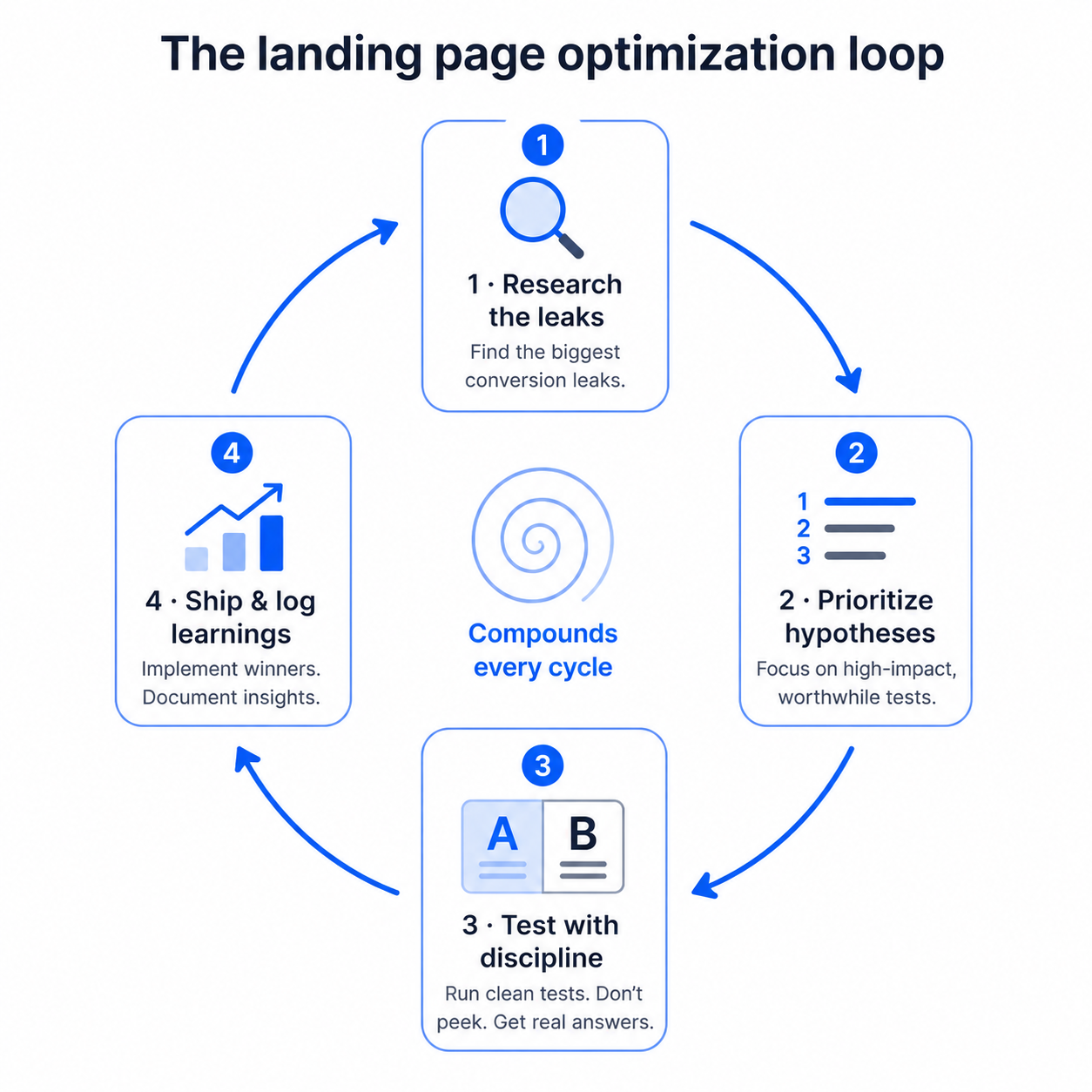
Opinion is the enemy of optimization. Before forming a single hypothesis, gather evidence from four sources. Quantitative: GA4 funnel reports showing the exact step where drop-off concentrates, segmented by device and traffic source — a page converting fine on desktop and dying on mobile is a different problem than one failing everywhere. Behavioral: heatmaps and session recordings (Clarity or Hotjar) revealing where visitors stall, rage-click, and abandon scroll. Voice of customer: on-page exit surveys ("what stopped you today?") and review mining for the language and objections buyers actually have. Competitive: what the pages your audience also sees are promising, so you know the context your claims land in.
Step 2 — Turn observations into a ranked backlog
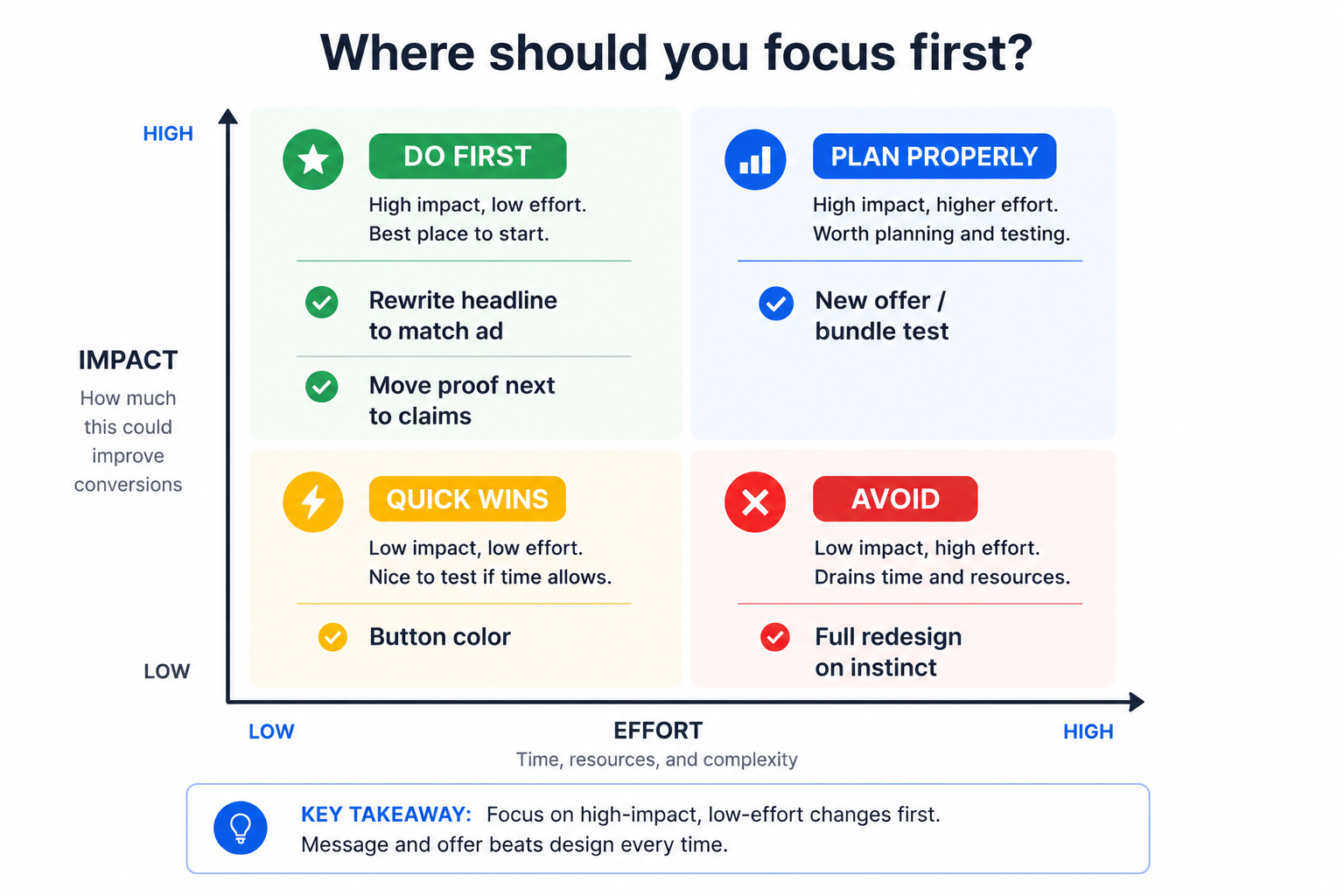
Every observed leak becomes a written hypothesis: "Because [evidence], we believe [change] will [expected effect] for [audience]." Rank the backlog by expected impact against implementation effort — an ICE or PIE score works fine — and resist the urge to bundle five changes into one redesign. Bundled changes can lift the page, but they teach you nothing, and learning is the compounding asset. The highest-impact hypotheses are almost always offer- and message-level (what the page says), not cosmetic (how it looks).
Want the research step done for you, free?
Get the 10-point audit →Step 3 — Test with statistical discipline
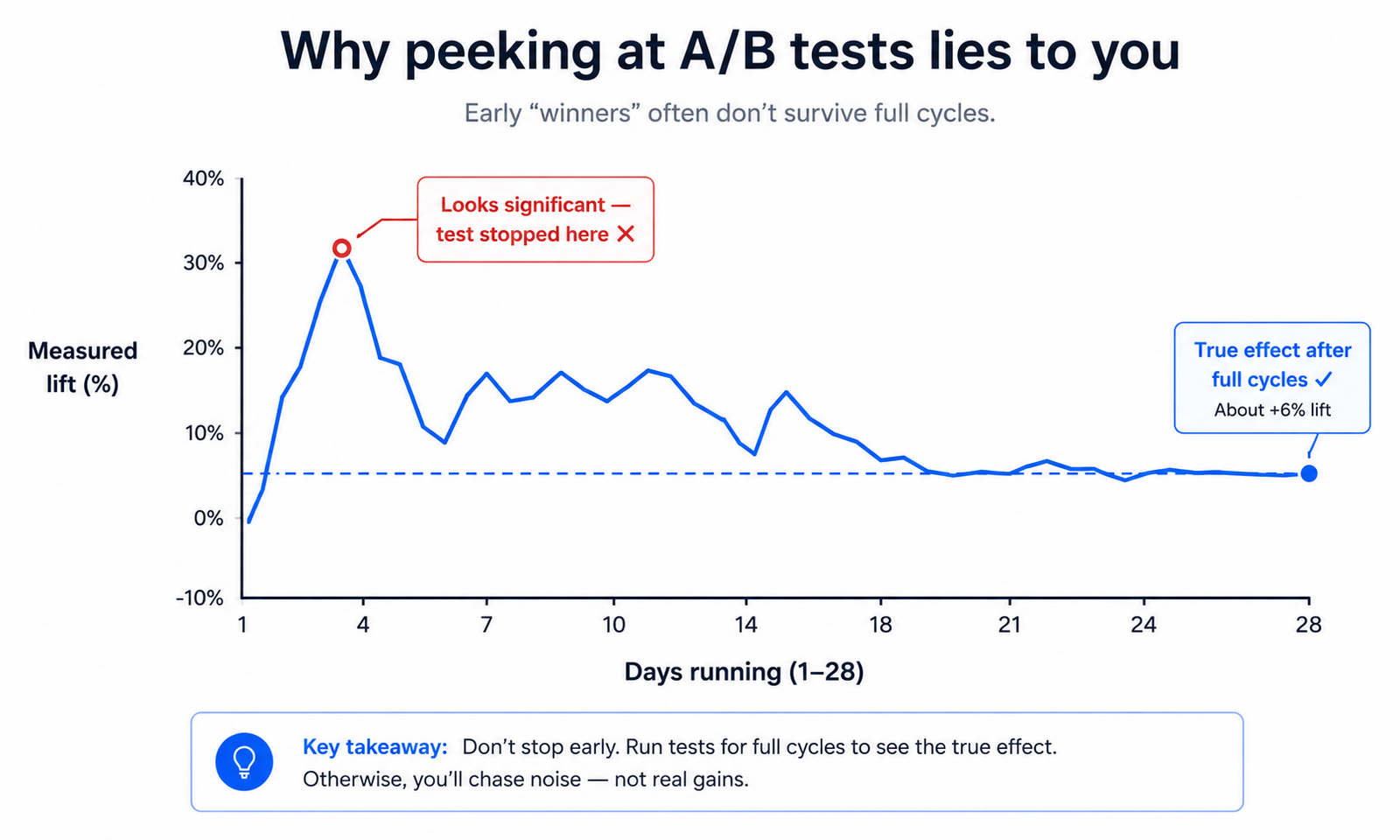
A/B testing fails silently when run casually. The discipline that keeps results honest: size the test before launch (decide the minimum detectable effect and required sample — for most pages that's thousands of sessions per variant, not hundreds); run full business cycles (whole weeks, since weekday and weekend traffic behave differently); don't peek and stop at the first significant blip — early "significance" regularly evaporates; and measure revenue per visitor alongside conversion rate, because a CVR win that drags AOV down is a loss in disguise. Pages with under roughly 10,000 monthly sessions usually can't sustain meaningful testing — in that case, ship evidence-based changes directly and measure before/after, or fix the foundation with a rebuild first.
Step 4 — Ship winners and feed the learning back
The loop only compounds if it closes. Ship winning variants to 100% of traffic promptly — a proven winner sitting in a testing tool is revenue on pause. Log every test, win or lose, in a simple decision record: the hypothesis, the evidence behind it, the variant, the result, and what it says about your audience. Losers are not failures; they're information about what your buyers don't care about, which quietly saves every future campaign from repeating the mistake. Then feed the learnings into the next research round: a winning proof-placement pattern on one page becomes the starting hypothesis for its siblings, and the backlog gets smarter every cycle. Teams that skip this step don't run an optimization program — they run disconnected experiments that reset to zero each quarter.
Landing page optimization tools worth using
The stack doesn't need to be expensive. Analytics: GA4 for funnels and segmentation. Behavior: Microsoft Clarity (free) or Hotjar for recordings and heatmaps. Testing: your platform's native testing (Shopify A/B apps, Unbounce or Instapage built-ins — note that most builders gate testing above their entry tiers, mapped in our landing page builders comparison) or GrowthBook/VWO for custom builds. Speed: PageSpeed Insights and WebPageTest against the LCP < 2.5s standard. Surveys: a one-question exit poll outperforms most expensive research. Tools gather evidence; they don't generate hypotheses — that part stays human, which is the premise behind our whole landing page optimization service.
The metrics that matter beyond conversion rate
Conversion rate is the headline metric but never the whole story. Track revenue per visitor (CVR × AOV) as the primary decision metric; CPA to connect page performance to ad economics; AOV to catch wins that quietly shrink order size; and where the business model allows, cohort LTV — the metric behind the pet health program above, where an LTV view surfaced winners that conversion rate alone would have rejected. The discipline in the four steps is the entire difference between that outcome and a year of random button colors.