How we evaluated these tools
We're a landing page design service, not a software vendor — we build and optimize pages for clients on several of the platforms below, and none of them pays us or earns us an affiliate commission. That day-to-day work shapes what we judged each tool on: how fast a competent marketer can ship a page, how deep the built-in testing goes (and at which tier it actually unlocks — the industry's quietest pricing trick), how clean the output is for Core Web Vitals, how well it fits ecommerce versus lead gen, and what the entry price really buys. Prices below are entry tiers verified in July 2026, generally on annual billing; vendors change them often, so confirm on their pricing pages before committing. And if you're still deciding whether you need a standalone page at all, start with our guide to landing pages vs websites.
The best landing page builders compared
| Builder | Best for | Starting price* | Strengths | Watch out for |
|---|---|---|---|---|
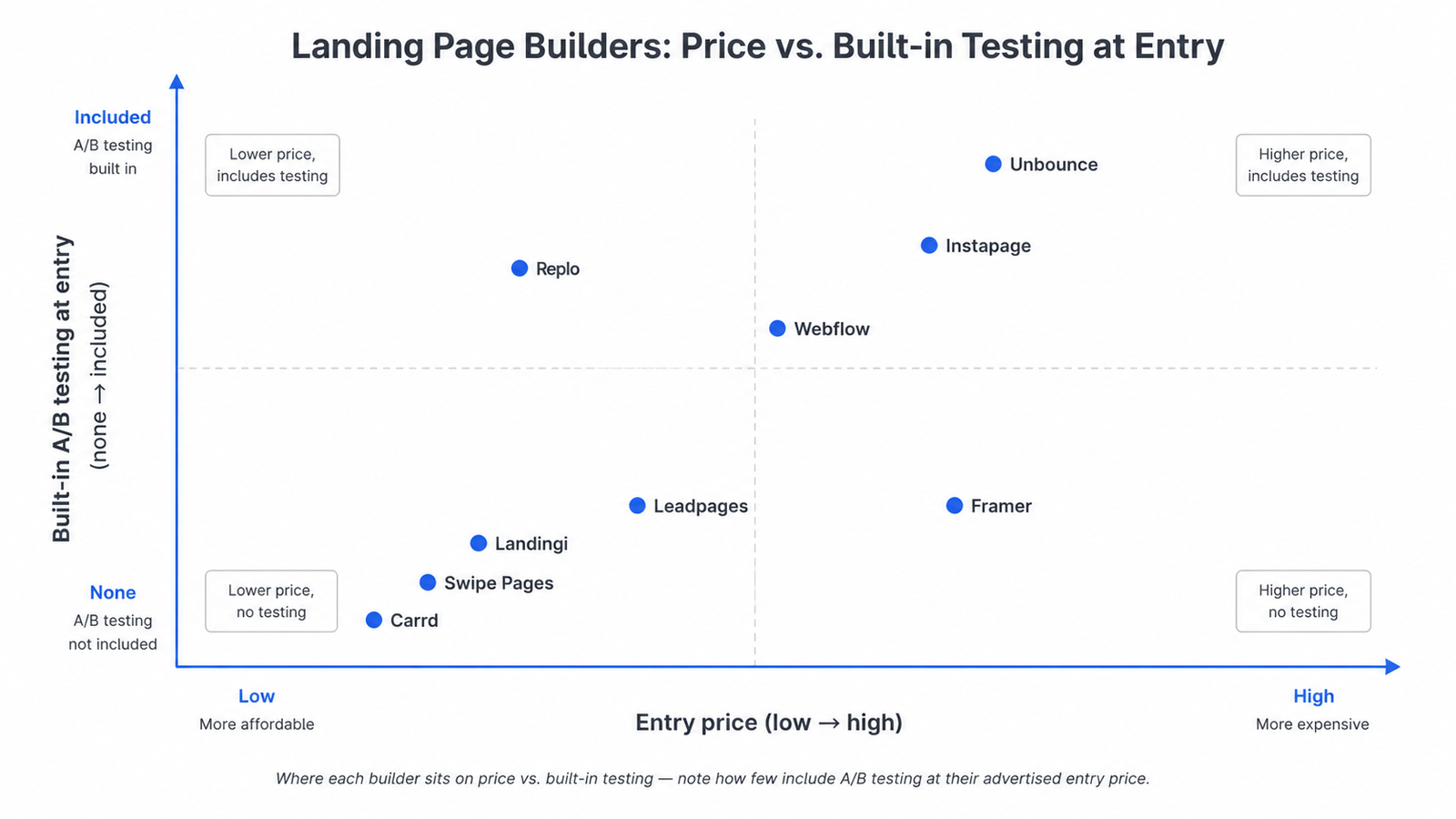
| Unbounce | Testing-led marketers | From $29/mo (A/B testing from $149/mo) | Mature testing suite, AI traffic optimization, big template library | Testing isn't on the entry tiers; visitor caps on every plan |
| Instapage | Teams running heavy ad spend | From $79/mo annual (testing from $199/mo) | Ad-to-page personalization, collaboration workflows | Premium pricing — overkill below serious spend; 15K visitor cap at entry |
| Replo | Shopify DTC brands | From $99/mo | Native Shopify publishing, ecommerce components, testing included on paid plans | Shopify-only; quality varies with the template you start from |
| Webflow | Design-control teams | Site plans from $14/mo annual | Near-total design freedom, clean output, strong CMS | Real learning curve; testing needs third-party tools; layered pricing |
| Leadpages | Value-priced testing | From $49/mo annual | A/B testing and uncapped traffic included at entry | Less design flexibility than Unbounce or Webflow |
| Framer | Fast, polished marketing sites | From $10/mo (Pro $30/mo) | Excellent visual quality, fast builds, strong performance | Native A/B testing only on the $100/mo Scale tier; younger ecommerce ecosystem |
| Carrd | Ultra-simple one-pagers | From $19/yr (Pro Standard) | Absurdly cheap, fast, clean single-page sites | One-page sites only; annual billing only; form submission caps |
| Landingi | Budget teams needing many pages | From ~$25/mo annual | Unlimited landing pages, reusable Smart Sections | Analytics are adequate rather than deep |
| Swipe Pages | Mobile-first paid campaigns | From $29/mo | AMP-fast mobile pages, funnel-oriented templates | Smaller ecosystem; fewer integrations than the big names |
*Entry-tier pricing verified July 2026, annual billing where noted. Always confirm current pricing with the vendor.
Unbounce — the testing veteran
Unbounce has been the default answer to "landing page builder" for over a decade, and its core strength remains experimentation: A/B testing, traffic-splitting, and AI-assisted optimization that routes visitors to the variant most likely to convert them. The drag-and-drop editor is capable if occasionally fiddly, and the template library covers most lead gen and SaaS patterns. The honest catch is the pricing ladder. Plans start at $29/month, but that tier caps you at 500 visitors; the realistic starting point is the $99 Build plan — which doesn't include A/B testing. Testing unlocks at $149 (Experiment), and the AI Smart Traffic feature Unbounce is famous for sits on the $249 Optimize plan. Every tier meters your monthly visitors with overage charges beyond the cap. It suits marketers who plan to test continuously and will genuinely use that ladder; smaller teams often pay for a builder and discover the optimization they came for costs two tiers more.
Instapage — built around ad spend
Instapage's differentiator is post-click personalization: mapping many ad variations to matched page experiences at scale, which is genuinely valuable once you're running dozens of ad sets and serious monthly spend. Collaboration and review workflows are the best in the category. It's priced like the enterprise tool it is: the Create plan runs $99/month ($79 on annual billing) with a 15,000-visitor cap and no A/B testing — that starts on the $199 Optimize tier. Teams spending modestly on ads will pay for capability they won't use; teams matching large ad-set volumes to personalized pages will find nothing else does it as well.
Replo — the Shopify specialist
For Shopify stores, Replo removes the friction the general builders carry: pages publish as native Shopify pages, product data flows in directly, and ecommerce components (carts, bundles, subscription widgets) exist out of the box — with A/B testing included on paid plans, which start at $99/month. It's what we often recommend when a DTC team wants to iterate on pages we've designed, and it pairs naturally with the kind of paid-traffic pages we build in our ecommerce landing page service. The constraint is the obvious one — it's Shopify-only — and as with every template ecosystem, output quality tracks the thinking that goes in.
Webflow — maximum design control
Webflow is less a landing page builder than a visual development platform: near-total layout control, clean code output, and a real CMS. Teams with design skill produce genuinely custom pages without writing code. Site plans start around $14/month on annual billing (the CMS plan most content sites need is about $23), but note the layered model — workspace plans and ecommerce plans bill separately, so real costs climb for teams and stores. The other costs are time, since the learning curve is real, and testing, which requires third-party tooling. For one-off landing pages it can be more platform than the job needs.
Leadpages — testing without the tier ladder
Leadpages has quietly repositioned from "the cheap simple one" to the value play for optimization: entry plans from around $49/month on annual billing include A/B testing and uncapped traffic — the two things Unbounce and Instapage reserve for their $149–199 tiers. Conversion-oriented templates and fast setup remain the appeal for lead generation. The trade-off hasn't changed: less design flexibility than Unbounce or Webflow, so ambitious custom layouts will feel constrained. For small businesses that want to actually test pages without climbing a pricing ladder, it's become the rational default.
Framer — speed with polish
Framer produces the most visually refined output per hour of effort in this list, with strong performance scores and a pleasant, Figma-like editor. Pricing is friendly: the Basic plan is $10/month and the Pro tier most professional sites run on is $30/month (annual billing), with editor seats billed separately at $20/month each. It has real momentum with startups and marketing sites. Two caveats: the ecommerce ecosystem is younger than Replo's or Webflow's, and native A/B testing only arrives on the $100/month Scale plan — below that, testing runs through integrations. Fine for many teams, a dealbreaker for testing-led ones.
Carrd — the $19-a-year outlier
Carrd builds one-page sites and only one-page sites, and it prices like nothing else in this list: the free plan publishes up to three sites, and the Pro Standard tier — the one with a custom domain, forms, and analytics — costs $19 per year. Not per month. For validating an offer, a waitlist, a link-in-bio page, or a simple pre-launch capture, it's close to unbeatable value. The constraints are exactly what you'd expect at that price: single-page structure only, annual-only billing, monthly form submission caps, and no built-in testing. It's the right tool for the smallest jobs and the wrong tool the moment a campaign needs multi-page flows or real optimization.
Landingi — unlimited pages on a budget
Landingi's pitch is volume economics: plans from roughly $25/month on annual billing with unlimited landing pages, which matters for affiliates, agencies, and small teams spinning up many campaign variants. Its Smart Sections feature — edit a reusable block once and it updates across every page using it — is genuinely useful at that volume, and something pricier tools gate behind higher tiers. The trade-off is depth: analytics are adequate rather than extensive, so serious measurement means pairing it with GA4 or a dedicated analytics tool.
Swipe Pages — built for mobile speed
Swipe Pages specializes in the thing most builders treat as an afterthought: mobile load speed. It builds AMP pages that load near-instantly on phones, which directly matters when most of your paid traffic is mobile — speed is conversion rate on a 4G connection. Plans start at $29/month with multi-step forms and funnel-oriented templates included. The ecosystem is smaller than the big names', with fewer native integrations, so check your stack connects before committing. For mobile-heavy Meta and TikTok campaigns on a budget, it punches above its price.
Which landing page builder should you choose?
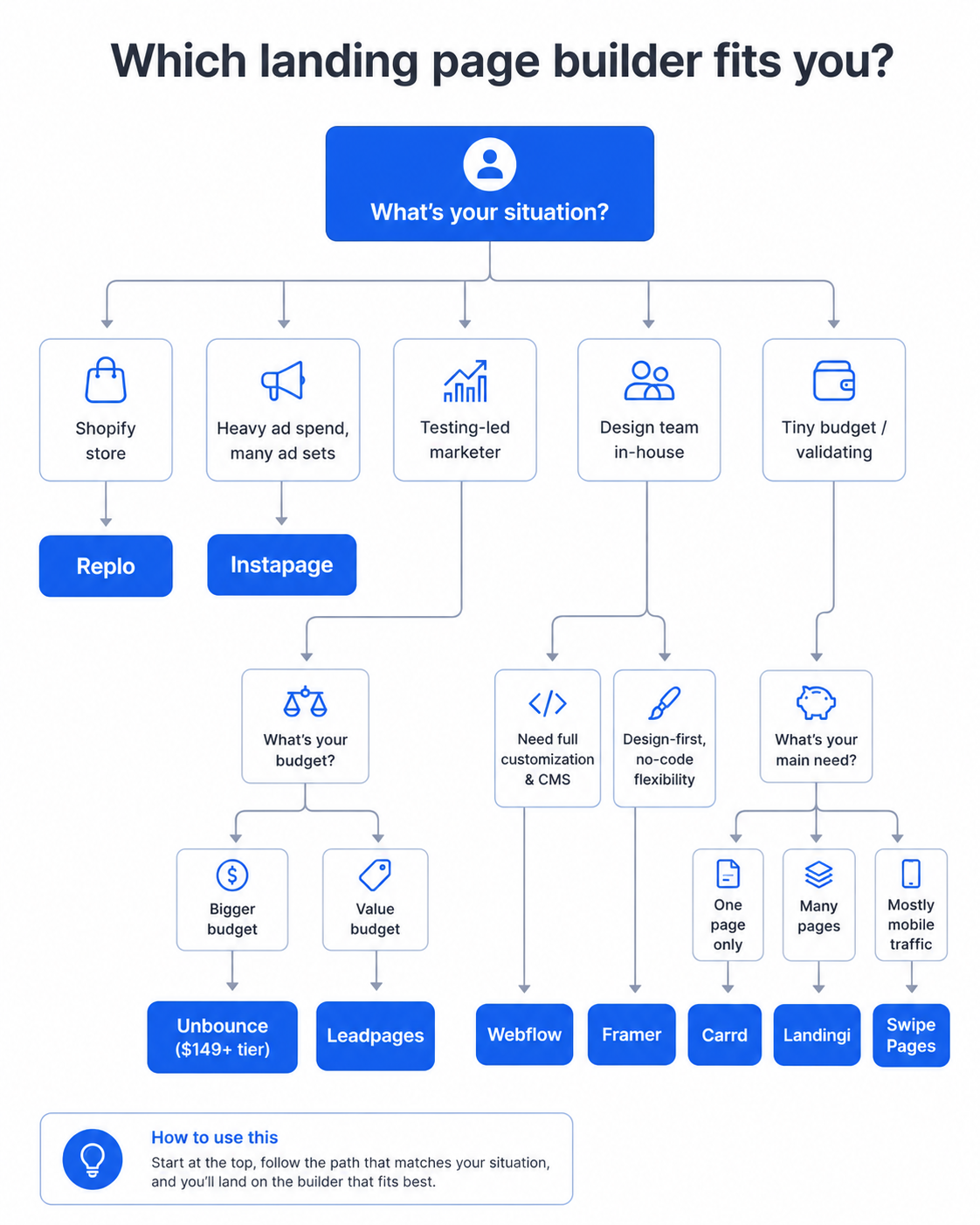
Match the tool to your actual situation rather than the feature grids:
You run a Shopify DTC brand → Replo. Native publishing and ecommerce components beat adapting a general builder. You're testing-led with real traffic volume → Unbounce, budgeted at the $149+ tier where testing lives — or Leadpages if you want testing at entry price. You're spending heavily on ads across many ad sets → Instapage; its ad-to-page mapping is worth the premium at scale, and not before. You have design skill in-house and want full control → Webflow, or Framer if speed and polish matter more than CMS depth. You're validating an offer on a tiny budget → Carrd for a one-pager, Landingi if you need many pages, Swipe Pages if your traffic is mobile-first. You have no one to do strategy and copy → no builder fixes that; solve the strategy layer first, then pick the cheapest tool that fits your platform.
What no landing page builder gives you
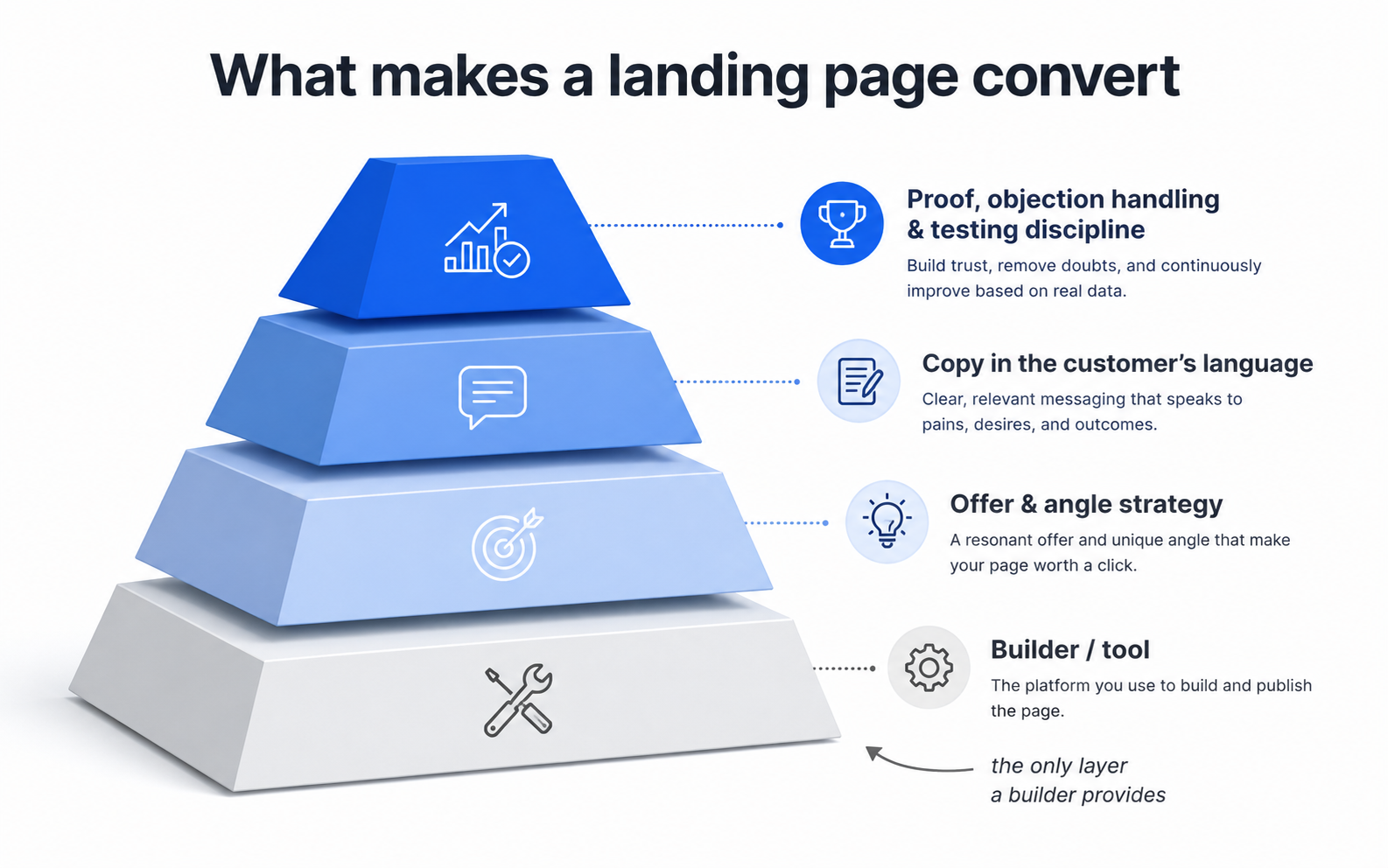
Every tool above solves the same layer of the problem: putting a page on the internet. None of them supplies the layers conversion actually comes from — knowing which angle fits your traffic, writing copy in your customers' language, sequencing proof against real objections, and testing with statistical discipline. That's why two brands can use the same builder and the same template and get a 1% page and a 6% page; the difference is the thinking, not the tool, and it's the same gap our landing page best practices guide exists to close. If you have that strategy capacity in-house, a builder is all you need. If you don't, that's the gap our done-for-you landing page creation service fills — we'll happily build on whichever tool from this list your team prefers, or hand-code it. Either way, start by knowing where your current page leaks: the free 10-point audit tells you in 48 hours.